Palm oil prices face pressure
1 RM (Malaysian Ringgit) = 0.24 USD
1 USD = 0.75 GBP
*Exchange rates calculated and market prices reported on 3rd December 2025
Crude Palm Oil
Average World Bank November 2025 palm oil price
US$970/tonne -US$68)
 Malaysia palm market
A little more volatility in the market
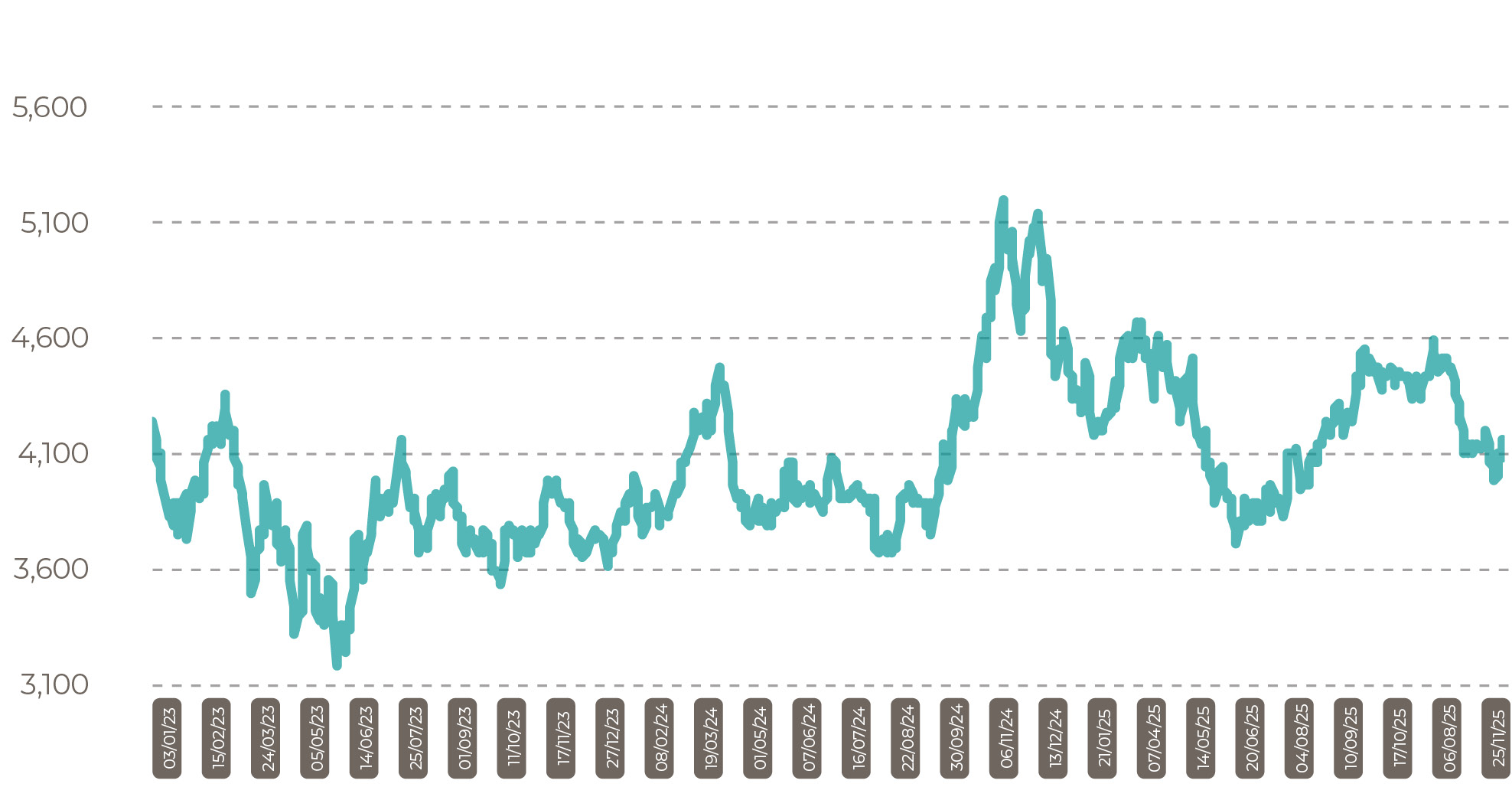
After a month of very stable prices, there was some volatility in the Malaysia CPO settlement price in the second half of November.
The price rose from RM4,125/tonne (US$990) on the 14th of November to RM4,215/tonne (US$1,012) on the 19th of the month – a rise of 2.2%. But then the price started to fall – it bottomed out at RM3,994/tonne (US$959) on the 25th of November, a drop of 5.2% and the lowest price since the beginning of July 2025. The price then rose by 4.0%, settling at RM4,156/tonne (US$997) on the 3rd December.
The latest price is 1% more than the month before, 15.4% lower than the year before and 41.5% less than the all-time high in April 2022.
Malaysia CPO Settlement Price RM
Vegetable oil
Palm oil prices follow crude oil down, with other vegetable oils holding steady
Global average palm oil prices fell 6.5% in November to US$970/tonne, according to the World Bank, which was down 17.0% on the year before. Palm kernel oil prices fell 5.8% in the month, but were up 6.2% over the year, to US$1,241/tonne.
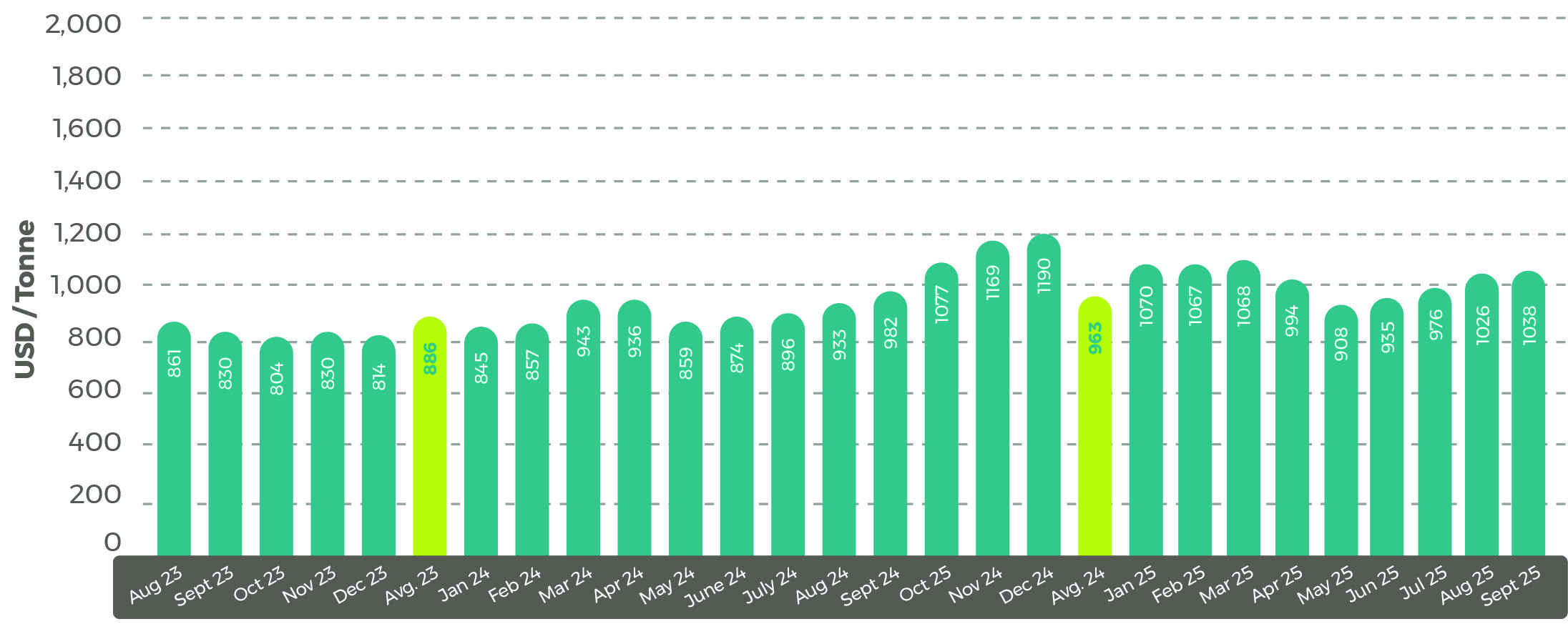
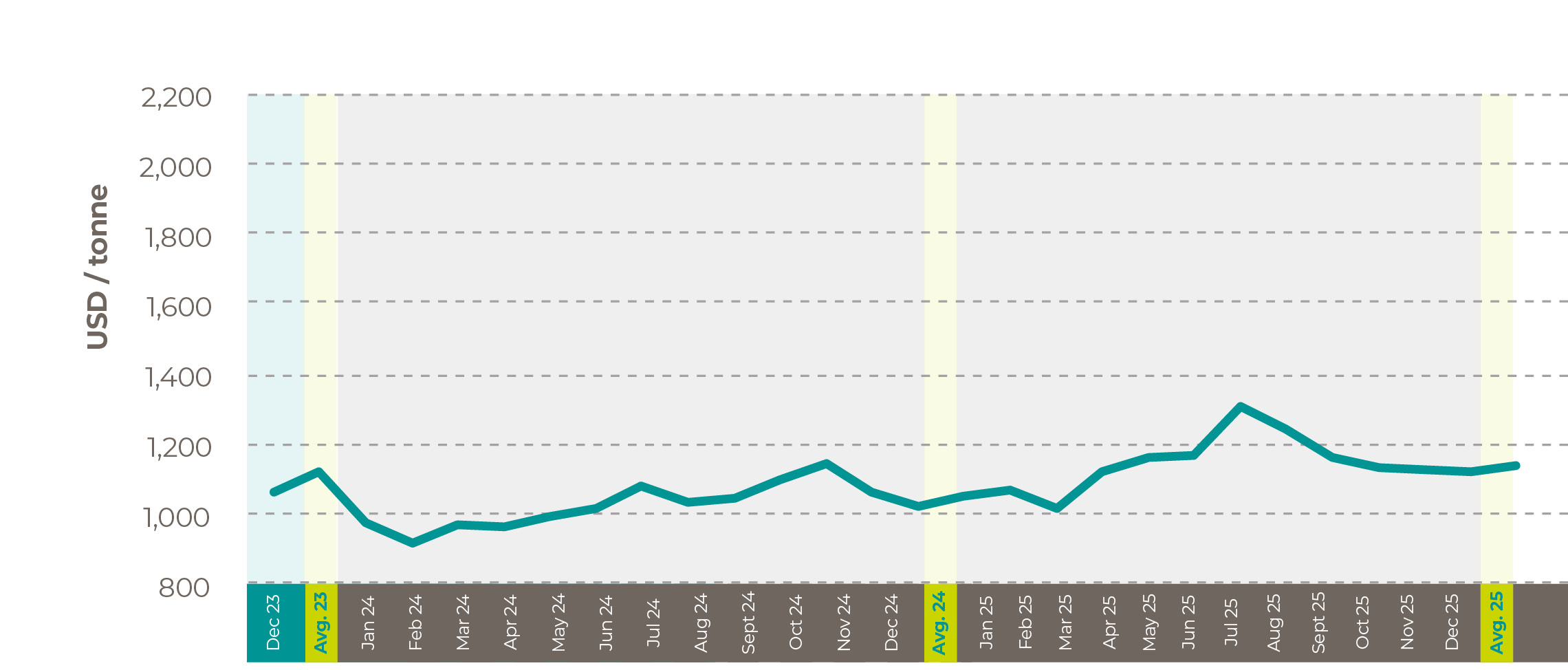
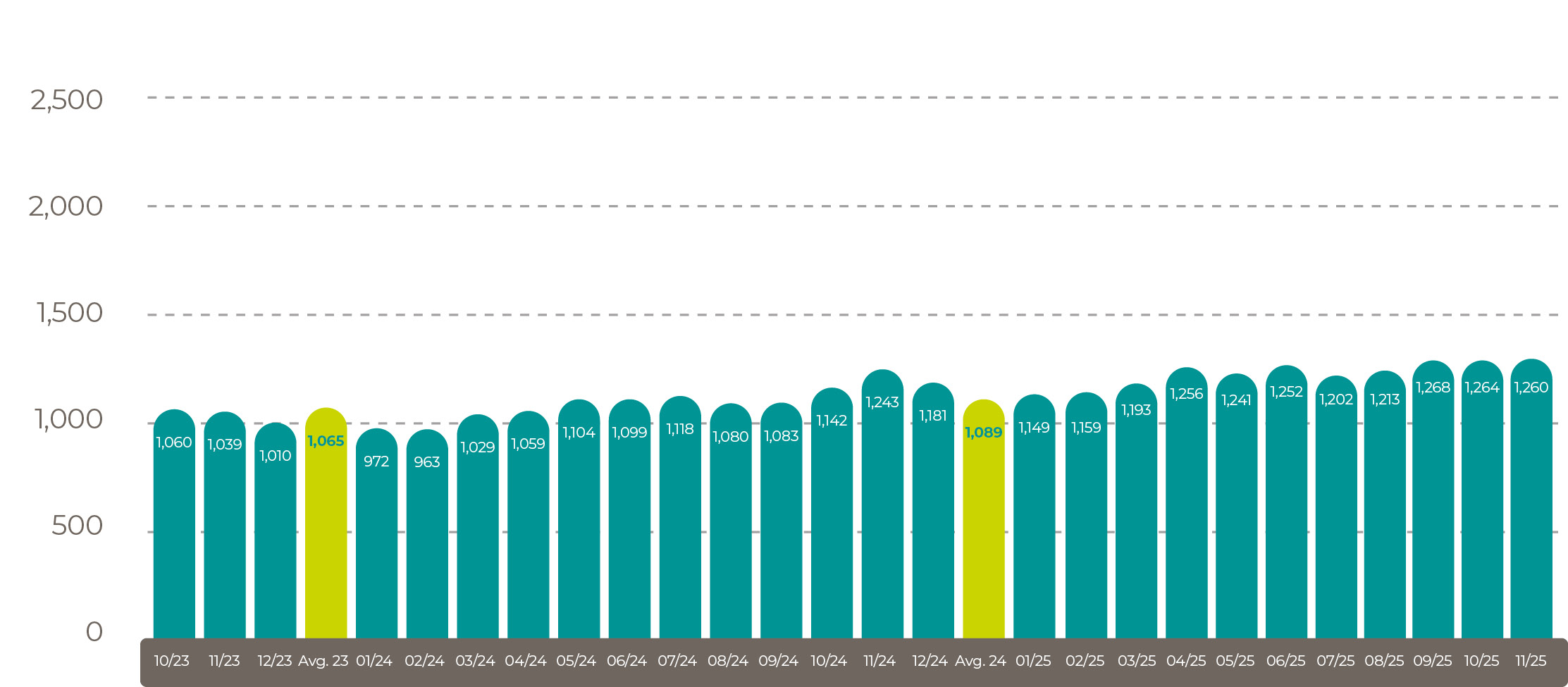
Palm oil prices followed crude oil values down, which dropped by 1.1% in the month and by 13.8% over the year to US$62 a barrel. Other vegetable oils performed better than palm oil. Rapeseed oil was down 0.3% in the month and up 1.4% over the year to US$1,260/tonne, with sunflower oil down 0.8% on the month and up 6.7% on the year to US$1,352/tonne. Soybean oil fell 0.5% in the month and by 1.7% over the year to US$1,126/tonne.
The US Government shutdown is now over, but there has not been a vegetable oil update since September. However, one is expected this month. There were supply and demand estimates for oilseeds from the USDA. The November estimate of global vegetable oil production is at 234.40 million tonnes in 2025/26, which is similar to the September projection and 1.9% more than the year before. Total use for 2025/26 is projected to up 2.9% on the year to 228.81 million tonnes, with stocks down 0.6% to 29.95 million tonnes. Production of oilseeds is projected to be up 0.6% to 688.01 million tonnes, with stocks up 0.4% to 142.26 million tonnes.
Average world soybean oil prices in US$/tonne
Rapeseed oil
Average world rapeseed oil price in US$/tonne
Sunflower oil
Average world sunflower oil prices in US$/tonne
Shipping update
Costs at the lowest point in the last year
After a very small rise in shipping costs during October and early November, prices fell again later in the month. By the 27th of November, they were at US$1,806 per 40-foot container, which was 2.5% less than the week before. That was 47.1% less than the year before, with costs falling by more than US$1,700 since June this year.
From the 27th November 2025 Drewry World Container Index report:
- The Drewry World Container Index (WCI) decreased 2% to $1,806 per 40-foot container. The decline was primarily due to reduced rates on the Transpacific and Asia–Europe trade routes.
- Spot rates on the Transpacific head haul route continue to decrease for the third consecutive week, with rates from Shanghai to New York falling 6% to $2,735 per 40-foot container and rates to Los Angeles reducing 4% to $2,089. According to Drewry’s Container Capacity Insight, blank sailings on the Transpacific trade are expected to decrease next week, which could increase available capacity. Consequently, Drewry anticipates a slight softening in rates next week.
- After 6 weeks of continuous increase, spot rates on the Asia–Europe trade route decreased this week, with rates from Shanghai to Genoa and Rotterdam falling 1% this week, to $2,300 and $2,165 per 40-foot container. Carriers on this trade route are attempting to raise spot rates by implementing higher FAK levels, ranging from $3,100 to $4,000 per 40-foot container, effective 1 December. This move is aimed at boosting spot rates ahead of the upcoming annual contract negotiation season.
The national strike in Belgium has disrupted port operations and increased congestion at the Port of Antwerp. This congestion is expected to worsen as a few carriers are planning to return to the Suez Canal route, which will further strain port efficiency, leading to longer delays and surging spot rates. - Drewry’s Container Forecaster expects the supply-demand balance to weaken in the next few quarters, particularly if normal Suez Canal transits resume.
Source: Drewry Supply Chain Advisors
Disclaimer: The information in this document has been obtained from or based upon sources believed to be reliable and accurate at the time of writing. The document should be for information purposes only and is not guaranteed to be accurate or complete.