US and Iran agreement sends palm oil price to a monthly low
1 RM (Malaysian Ringgit) = 0.25 USD*
1 USD = 0.74 GBP
*Note, exchange rates are for June 15, 2026
The Malaysian palm oil settlement price has drifted down over the last few days, with the agreement between the US and Iran leading to lower crude oil prices.
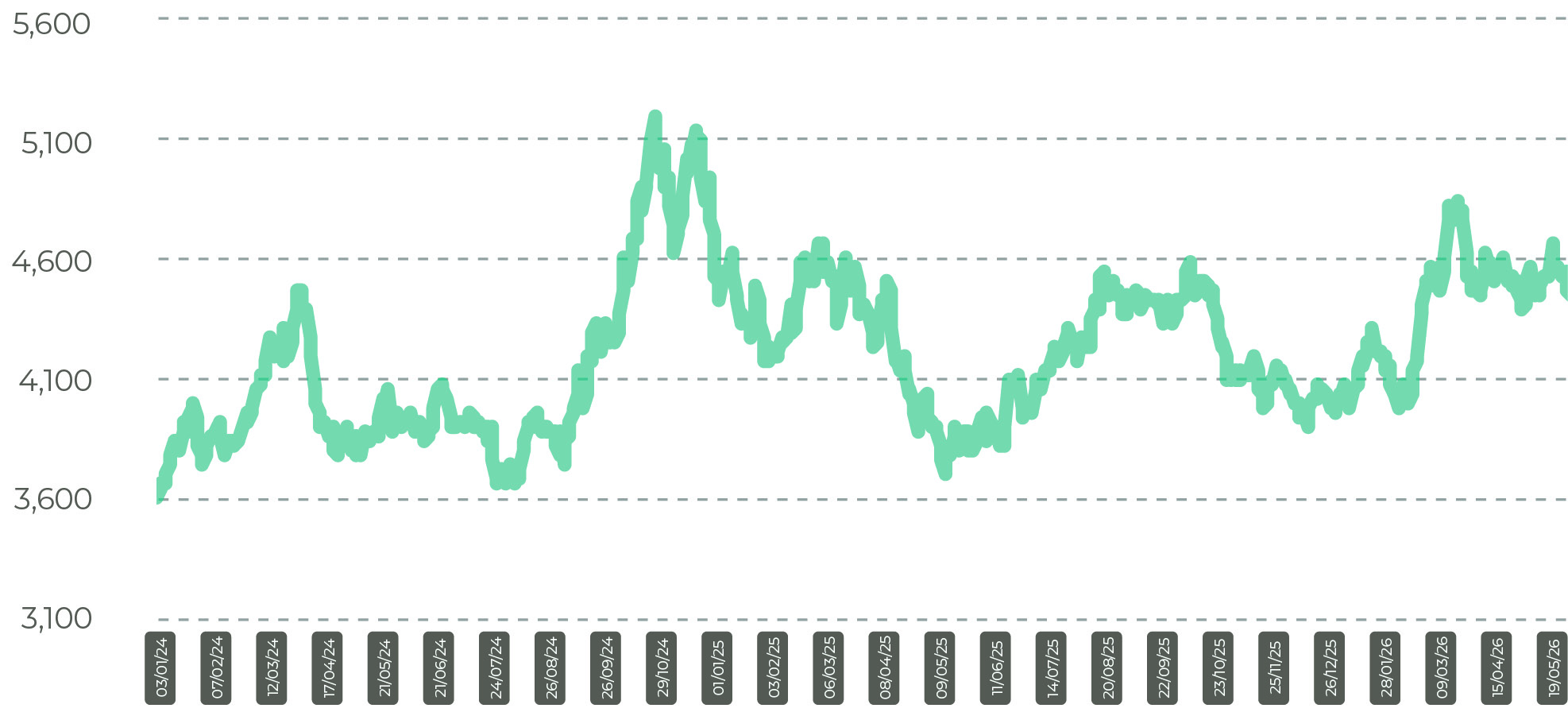
The price on May 15 was RM4,450/tonne (US$1,112/t). That was 8% lower than the price in early April, but still 10% more than the price before immediately before the Middle East conflict began. The latest price is 37.3% less than the all-time peak in April 2022 following Russia’s invasion of Ukraine.
The latest price represents a 1.9% drop from the June 1 value. It was also up 0.1% compared to the month before and 8.5% higher than the price a year before.
The change in prices over the last few weeks shows how sensitive the market is to political developments. If the agreement between the US and Iran falls apart, then it can be expected that palm oil prices will rise again.
Malaysia palm prices CPO Settlement Price RM
 Analysis: All vegetable oils see a decline in price
All oil – both crude and vegetable oils – saw price falls following the agreement between US and Iran. Crude oil prices are now at US$80 a barrel, the lowest price since the first week of the conflict in early March. The Dalian (China) exchange soyoil price fell 0.3% on the 15th, with the Chicago Board of Trade’s soyoil price down 1.8%.
“The futures were seen trading sideways after opening gap lower following a selloff in energy prices, Chicago soyoil and Chinese vegetable oil futures in today’s Asian hours,” Anilkumar Bagani, head of research at Mumbai-based vegetable oil broker Sunvin Group, told the Business Recorder.
After a month of weak exports, trade is flowing more freely again, with AmSpec Agri Malaysia estimating a 23.8% increase in shipments in the first half of June 2026 and Intertek Testing Services estimating a 9.6% increase.
El Niño could dramatically reduce palm oil output
Palm oil production in Indonesia and Malaysia could be threatened by a strong El Niño, which many are predicting over the next year.
A report by financial services platform Marex says that a strong El Niño could reduce global palm oil output in the two countries by 4.256 million tonnes, driving down the key stock-to-use ratio from 11.9% to 8.3%. That would be the 18th lowest ratio on record, with the Indonesian ratio at its lowest in 52 years. The impacts could last longer than the weather system itself, driving down stocks to just 6.9% of use.
Palm oil is the second most consumed vegetable oil in the world, and Indonesia is the second-largest supplier, accounting for 88% of global output, with Indonesia accounting for almost three-quarters of that figure.
Stronger Malaysian palm production and weaker exports in April
Malaysia’s palm oil production was down on the strong output seen in April, while exports remained under pressure.
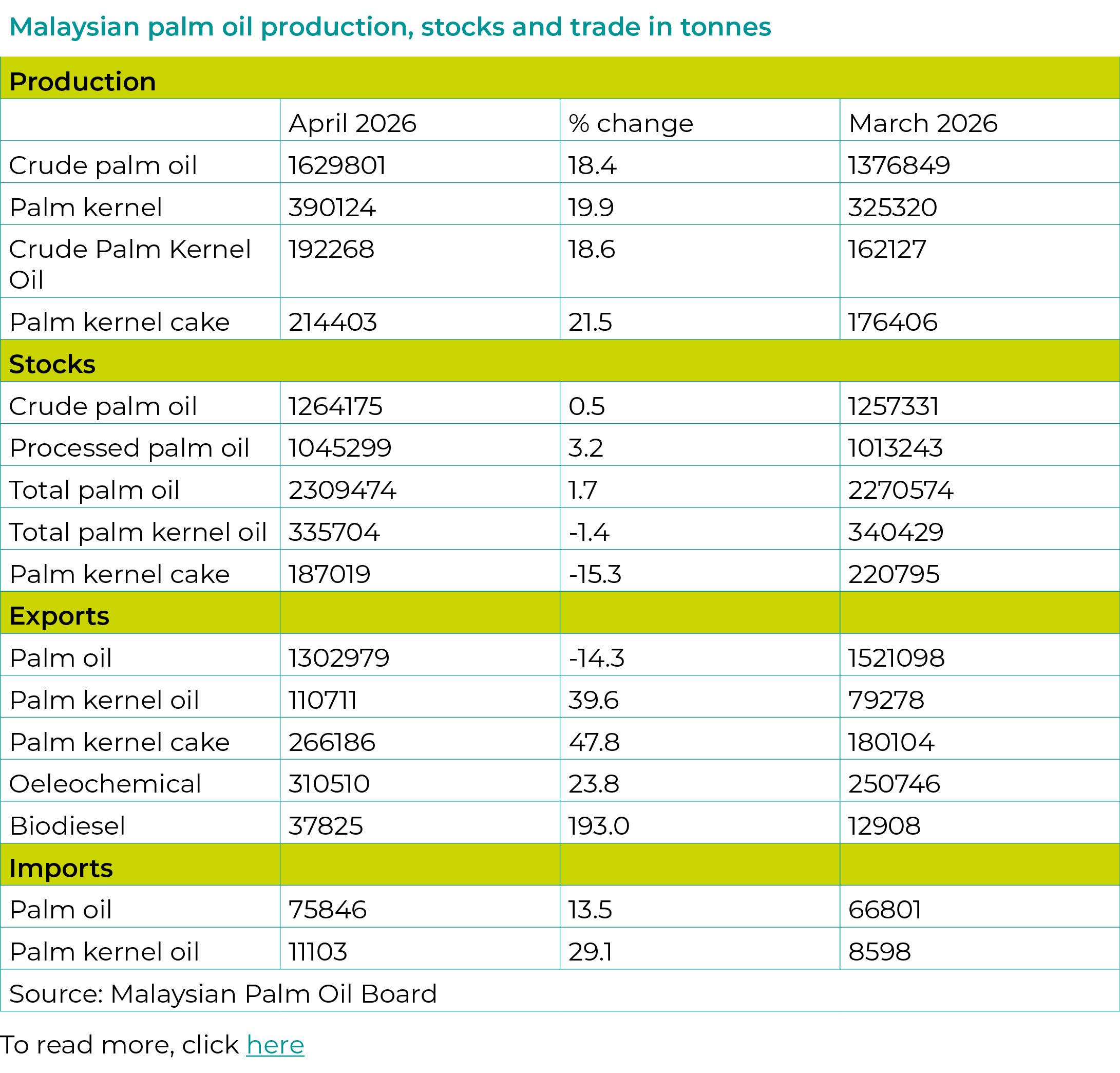
Output of crude palm oil was at 1.516 million tonnes in the month, according to the Malaysia Palm Oil Board, which was down 7% on the April figure. On a per day basis, the decrease was 10%. Palm kernel, crude palm kernel oil and palm kernel cake production for the month fell by almost 10% each.
Stocks of crude palm oil were up 1.6% to 1.285 million tonnes, with a 9.4% increase in processed palm oil stocks to 1.143 million tonnes. Exports of palm oil were down 14.5% in the month to 1.106 million tonnes, but exports of palm kernel products fell, while biodiesel shipments rose 9.3%.
Disclaimer: The information in this document has been obtained from or based upon sources believed to be reliable and accurate at the time of writing. The document should be for information purposes only and is not guaranteed to be accurate or complete.