Tighter market pushes up palm oil prices
1 RM (Malaysian Ringgit) = 0.25 USD
1 USD = 0.74 GBP
*Exchange rates calculated and market prices reported on June 3, 2026
Crude Palm Oil
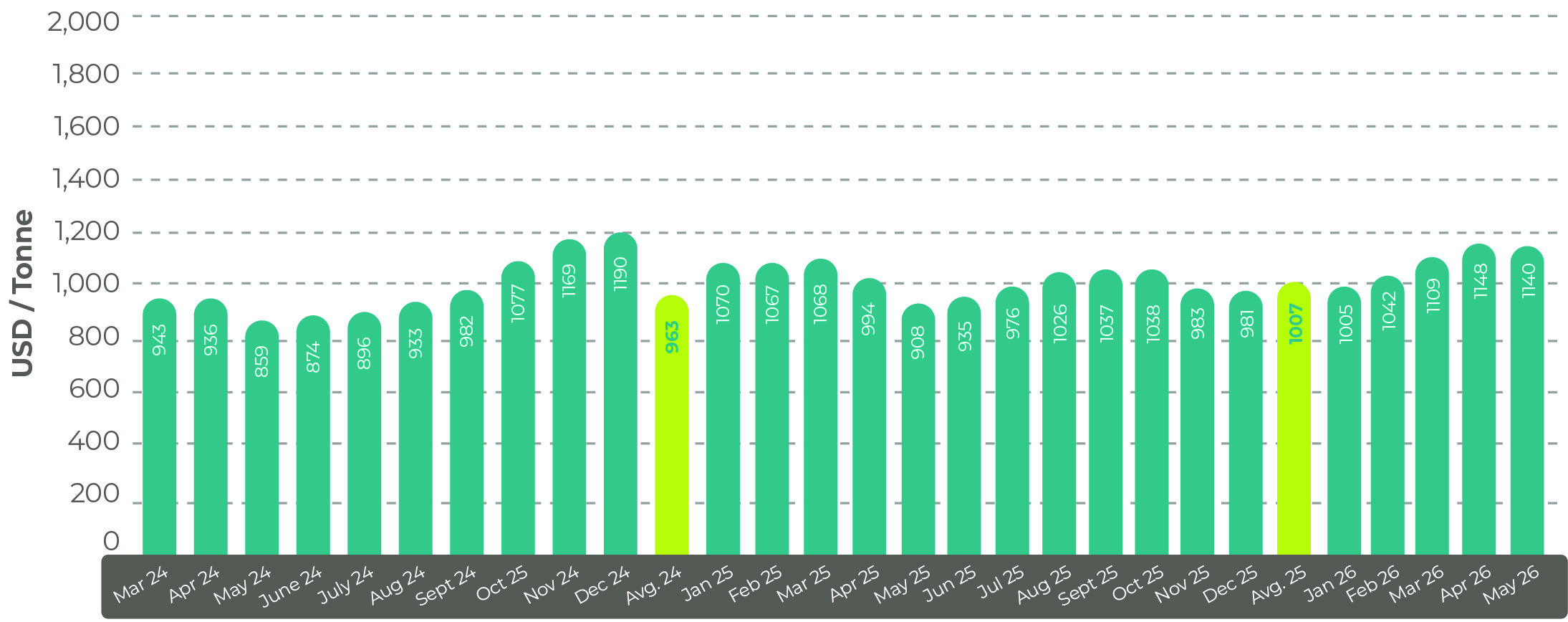
Average World Bank May 2026 palm oil price
US$1140/tonne (-US$8 in the month, a decrease of 0.5%)
 Malaysia palm market
Reduced exports and weaker Ringgit support prices
Malaysian palm oil prices rose in early June after slipping in mid-May. Reduced exports and a weaker Malaysian Ringgit helped push values up.
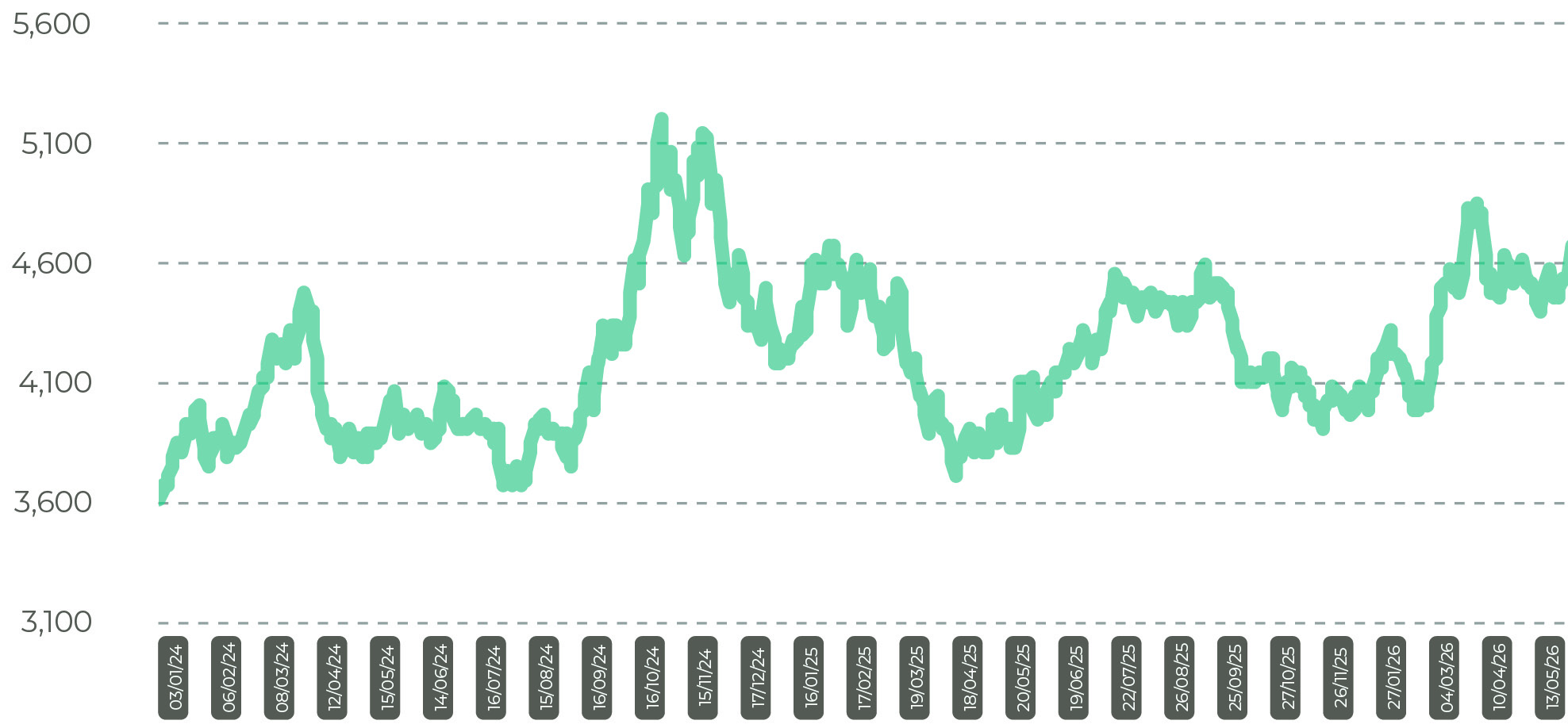
On June 3rd, the average Malaysian Palm Oil Settlement price on the Malaysian exchange was RM4,677/tonne (US$1,169), an increase of 2.9% on the day and 6.5% above the mid-May price, when values slipped on expectations of an agreement between the US and Iran over the Middle East conflict. The latest price was still 3.3% lower than the month before. It was 15.6% more than just before the Middle East conflict began in late February, 17.6% higher than the year before, but 34.2% less than at the all-time high in April 2022.
There were shipper reports that exports of Malaysian palm oil were down by as much as 18% in the first 25 days of May, while the Malaysian Ringgit has weakened by 3.8% against the US dollar over the last month.
Malaysia CPO Settlement Price RM
Vegetable oil
Global palm prices slip a little as other oils rose in May
The average global palm oil price rose 0.5% to US$1,140/tonne in May, down 0.5% on the month before but 25.6% up on May 2025. Average palm kernel oil prices were 7.3% down on the month and 20.6% higher on the year at US$2,416/tonne.
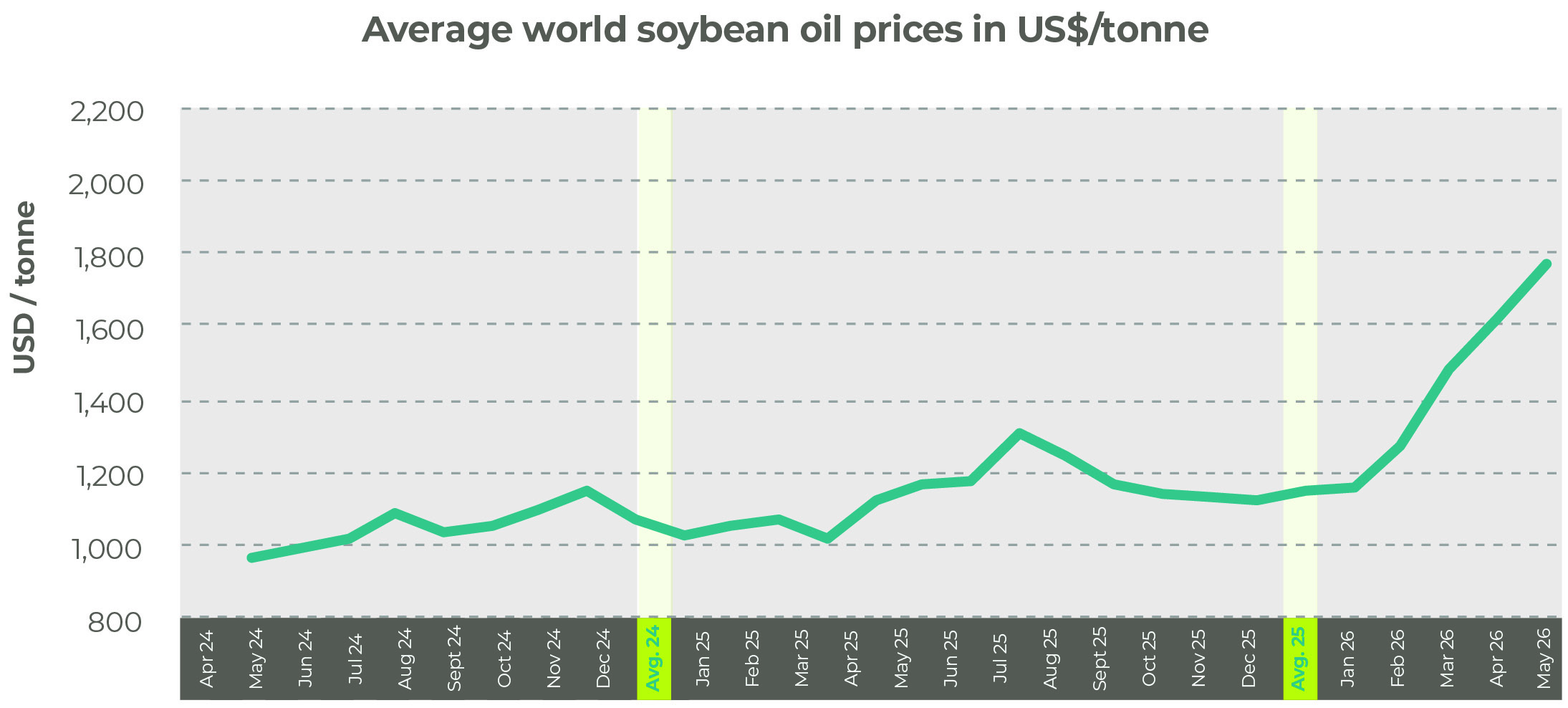
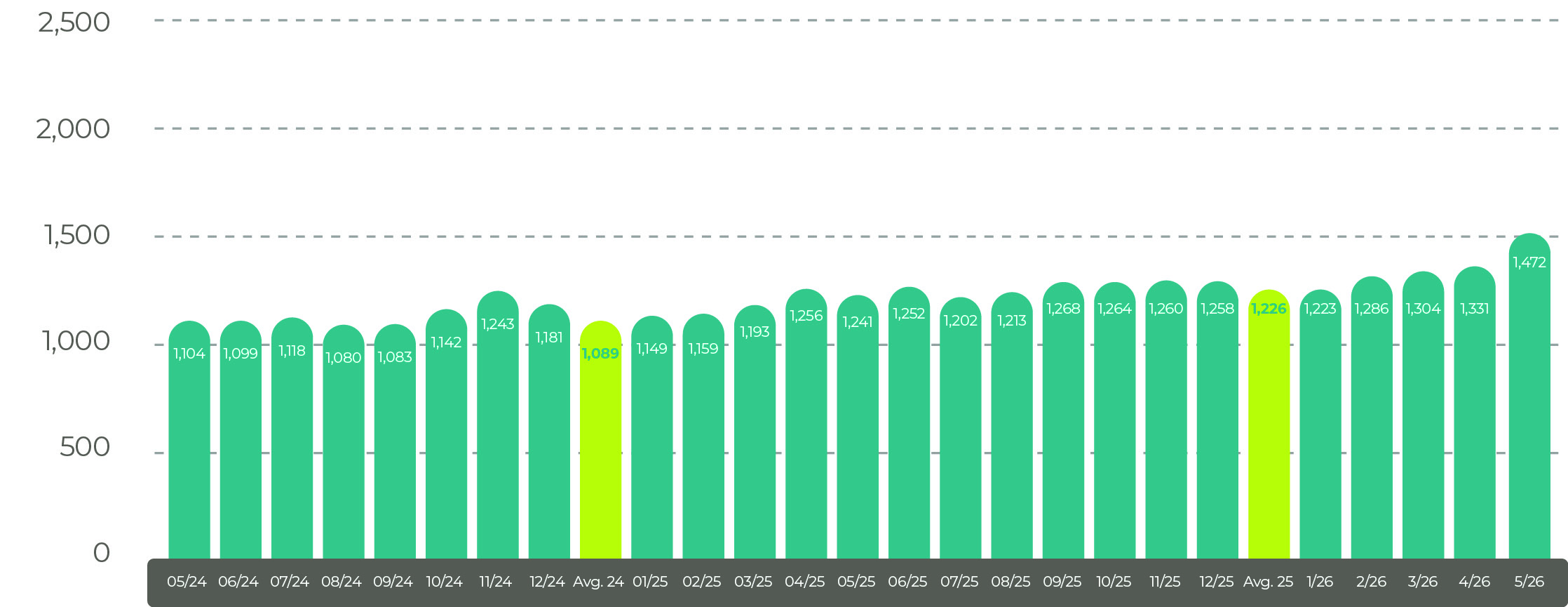
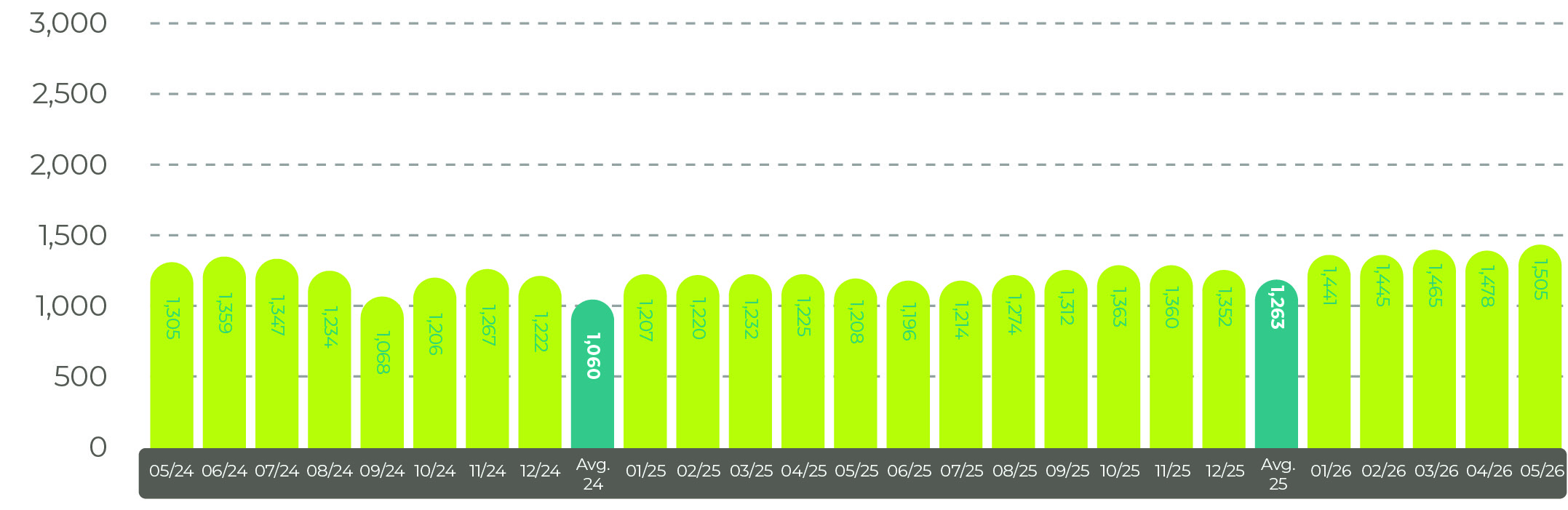
Soybean oil prices were up 42.6% on the year and 8.0% higher in April than in May at US$1,775/tonne. Rapeseed oil prices were up 9.5% in the month and 18.6% in the year to US$1,472/tonne. Sunflower oil prices increased 1.3% over the month to US$1,505/tonne, which was 24.6% more than May 2025.
Global oilseed production is forecast to reach a record 718 million tonnes in 2026/27, a rise of 3%, according to the US Department of Agriculture.
This increase is driven by an expansion of the global soybean area. The USDA expects global soybean production to increase by 3.3% or 14 million tonnes to 442 million tonnes. Brazil will again produce the largest soybean crop at an expected 186 million tonnes, 6 million tonnes more than in 2025/26. The US soybean crop is expected to increase by 5 million tonnes to 121 million tonnes, with an extra 2 million tonnes produced in Argentina for 50 million tonnes.
The global sunflower seed crop is also expected to be a record at 62 million tonnes, up 7 million tonnes on 20-25/26. This comes amid larger Russia and Argentine crops and a recovery in the Ukrainian crop after output fell to a decade-low last season. Rapeseed production should also be at a record – up one million tonnes to 97 million tonnes, driven by record Indian and Russian crops, decade-high EU production and a 22 million tonne Canadian crop.
Vegetable oil production is expected to be at 244.1 million tonnes in 2026/27, 2.9% more than in 2025/26. This is a result of an increase in trade by 3.6% to 88.4 million tonnes, and usage up 3% to 237.6 million tonnes, and ending stocks little changed at 30.3 million tonnes.
Average world soybean oil prices in US$/tonne
Rapeseed oil
Average world rapeseed oil price in US$/tonne
Sunflower oil
Average world sunflower oil prices in US$/tonne
Shipping update
Demand and political tension push logistics costs up
The Drewry World Container Index is at its highest level since July last year as seasonal demand for ships increases and disruptions to transport in the Strait of Hormuz in the Middle East continue.
The latest index price was US$2,800 per 40-foot container on May 28. That was 3% more than the week before, 26.3% more than the month before and 69.6% higher than the lowest point in the last year in October 2025. The cost is still 20.9% less than the peak in June last year.
The latest Baltic Dry Index is at 3,222 – up 14.2% on the month and more than double the cost at the start of 2026.
From the 28th May 2026 Drewry World Container Index report:
- The Drewry World Container Index (WCI) increased 3% to $2,800 per 40-foot container due to rate increases on the Asia–Europe and Transpacific trade routes.
- On the Asia–Europe trade route, spot rates increased again this week, driven by early peak season demand. Freight rates from Shanghai to Rotterdam rose 3% to $2,861 per 40-foot container, and those from Shanghai to Genoa increased 4% to $4,253 per 40-foot container. According to Drewry’s Container Capacity Insight, only four blank sailings have been announced on the Asia to Europe trade route for next week, indicating relatively stable capacity. CMA CGM has also announced new FAK rates, effective June 1, with Asia–Europe rates at around $4,700 per 40-foot container and Asia–Mediterranean rates in the range of $5,500–5,700 per 40-foot container. As the early peak season approaches and carriers continue to raise FAK rates, Drewry expects rates to rise further in the coming weeks.
- On the Transpacific trade route, spot rates climbed again this week, with Shanghai to New York rising 6% to $4,597 per 40-foot container, and Shanghai to Los Angeles increasing 3% to $3,473 per 40-foot container. According to Drewry’s Container Capacity Insight, eight blank sailings have been announced on the Transpacific trade route for the next week, indicating tighter capacity. ONE has announced a PSS (peak season surcharge) of $2,000 per 40-foot container on Transpacific eastbound cargo, effective June 1. With early peak-season trends emerging and seasonal demand strengthening through June, Drewry expects further upwards pressure on rates in the coming weeks.
- East–West container freight markets are strengthening as the peak season arrives earlier than usual this year. Demand is being pulled forward into June ahead of the expected July 1 bunker fuel adjustment, supporting stronger shipment flows. Carriers continue to raise rates through higher FAK (freight all kinds) levels and PSS while managing capacity via blank sailings and selective deployment. Geopolitical tensions in the Middle East are also weighing on sentiment, with elevated bunker costs and fuel surcharges adding further upwards pressure across trade lanes.
Source: Drewry Supply Chain Advisors
Disclaimer: The information in this document has been obtained from or based upon sources believed to be reliable and accurate at the time of writing. The document should be for information purposes only and is not guaranteed to be accurate or complete.