Palm oil prices still governed by Middle East conflict
1 RM (Malaysian Ringgit) = 0.25 USD
1 USD = 0.73 GBP
*Exchange rates calculated and market prices reported on May 5, 2026
Crude Palm Oil
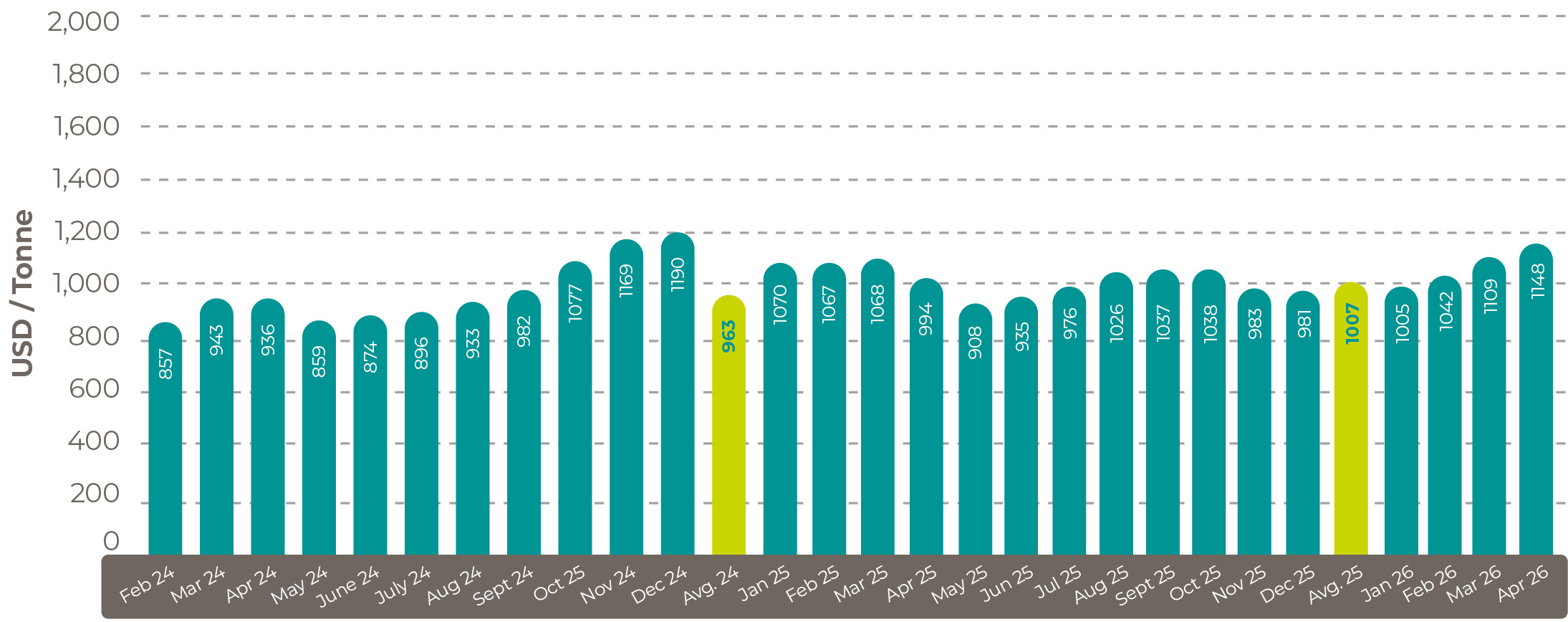
Average World Bank April 2026 palm oil price
US$1148/tonne (+US$39 in the month, an increase of 3.6%)
 Malaysia palm market
Weaker currency lifts prices
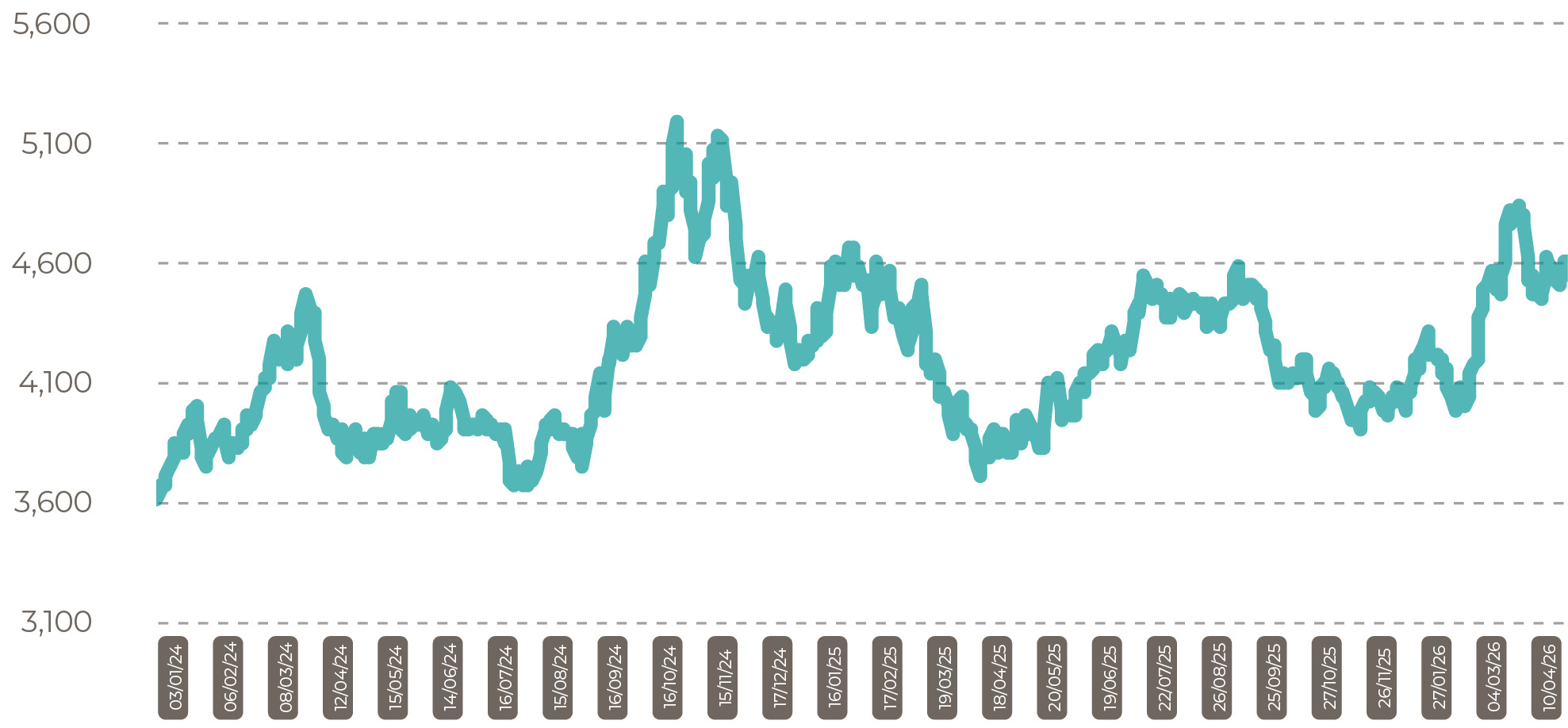
Malaysian palm oil prices rose towards the end of April, supported by a weaker Malaysian Ringgit and renewed tension in the Middle East.
By the end of the month, the average settlement price was RM4,563/tonne (US$1141). That was 2% higher than the mid-month price, although 5.5% lower than the price at the start of the month. The price was 16.6% higher than the year before, but still 35.8% less than the all-time high in April 2022.
Early May 2026 prices were slightly higher again, with the May 5th price at RM4,622/tonne (US$1,156). As well as a weaker Ringgit, prices were supported by news that Malaysia is set to increase biodiesel production in response to the continuing crisis in the Middle East, which has sent Brent crude oil prices rising above US$110 a barrel in recent weeks.
Malaysia CPO Settlement Price RM
Vegetable oil
Higher production in April as prices rise
The average global palm oil price rose 3.6% to US$1,148/tonne in April, 15.5% higher than the year before and the highest price since December 2024. The palm kernel oil price was 1.4% higher in the month, a 24.8% increase on the year at US$2,609/tonne.
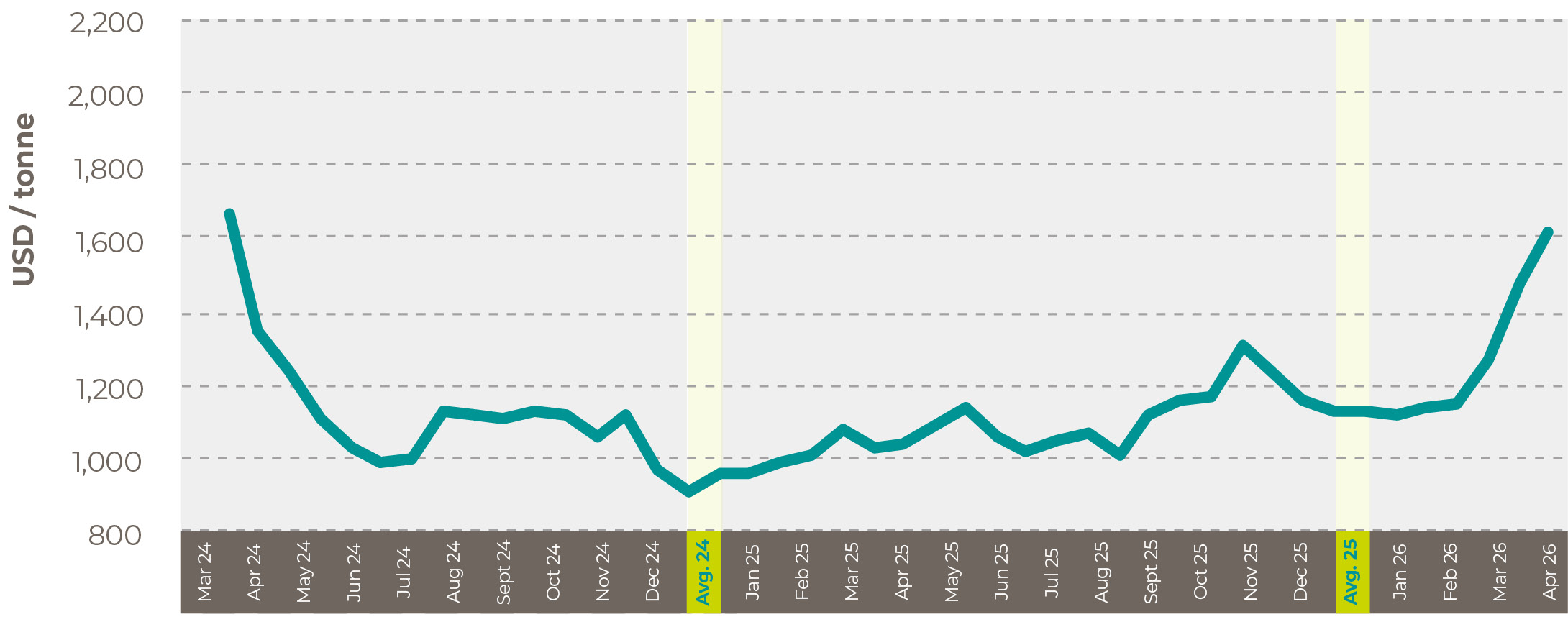
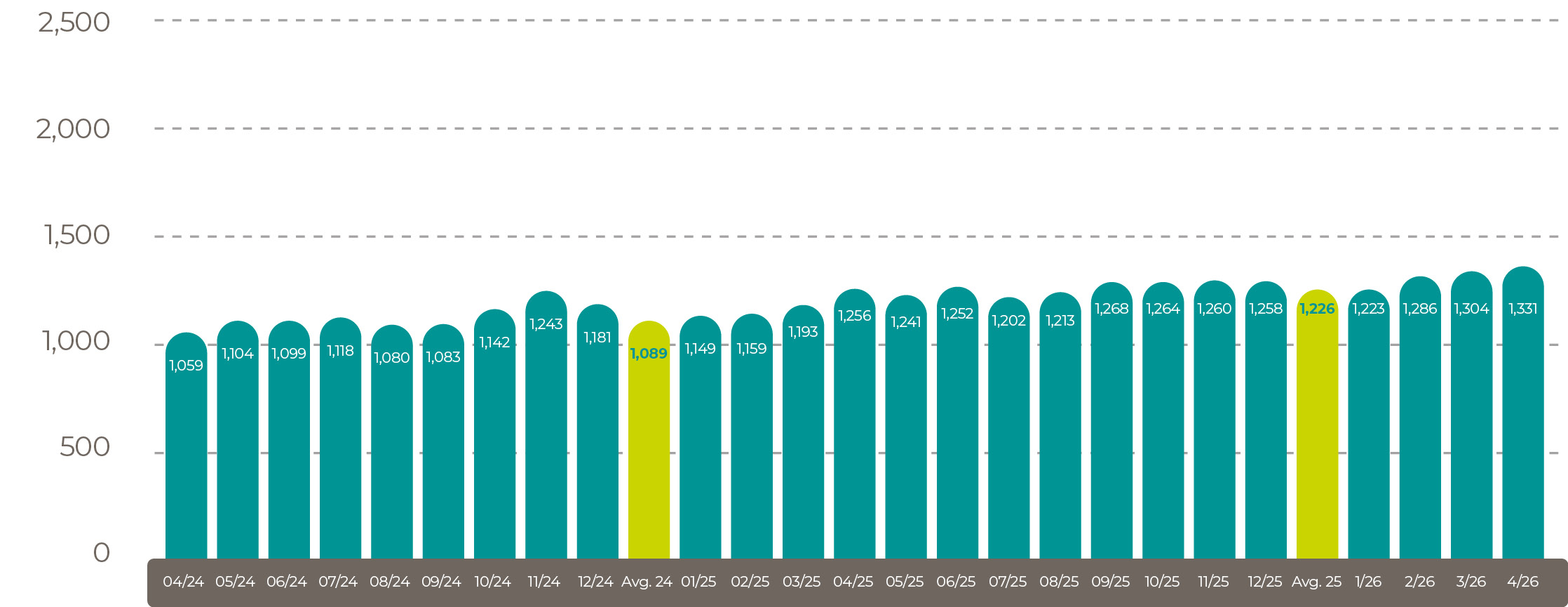
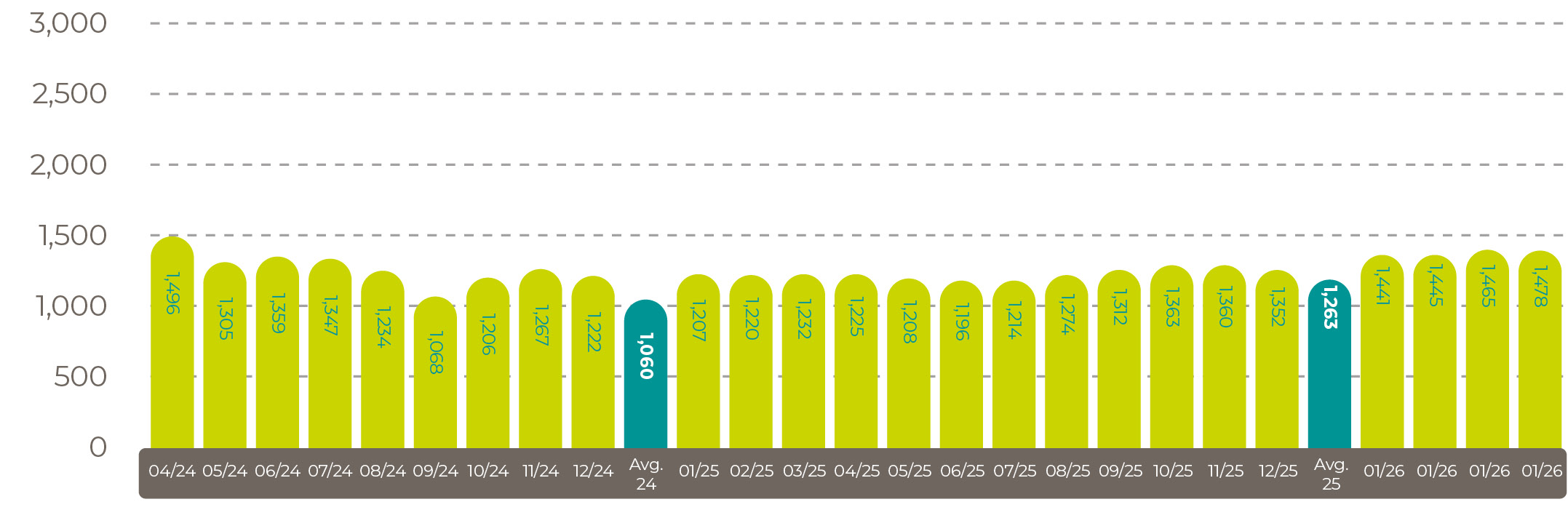
April soybean oil prices were 45.1% up on the year and 8.8% higher than in March at US$1,624/tonne. Rapeseed oil prices were up 2.0% in the month and 12.4% in the year to US$1,331/tonne, with a 0.9% increase in sunflower oil prices over the month to US$1,478/tonne, which was 20.7% more than in April 2025.
The US Department of Agriculture predicted lower Chinese peanut and Uruguayan soybean production in its April Vegetable Oil report, which was more than offset by greater production of Russian sunflowerseed, Paraguayan soybeans and Pakistani and Indian cottonseed. The department predicts a $0.10 increase in soybean prices to US$10.30 a bushel. Drought conditions in the key US Midwest region could increase oilseed prices further.
In its April World Agricultural Supply And Demand Estimate, the USDA raised its 2025/26 oilseed production estimate by 670,000 tonnes to a record 571.97 million tonnes, which is 3.9% more than the year before. Trade estimates were up 950,000 tonnes on the month to 171 million tonnes, with ending stocks down 1.49 million tonnes on the year to 134.42 million tonnes.
Vegetable oil production was estimated to have increased by 2.6% over the year to 221.43 million tonnes. Trade is expected to be similar to last year at 87.21 million tonnes, with ending stocks up 630,000 tonnes to 29.54 million tonnes.
Average world soybean oil prices in US$/tonne
Rapeseed oil
Average world rapeseed oil price in US$/tonne
Sunflower oil
Average world sunflower oil prices in US$/tonne
Shipping update
Drewry shipping index holds steady as other prices rise
Despite continued disruption to shipping in the Strait of Hormuz in the Middle East, the Drewry World Container Index fell US$16 per 40-foot container to US$2,216 in the week to the 30th April. That price was US$59 more than the year before, but 37.2% less than the peak in June of last year.
The index tracks trade routes from Shanghai, China to European and US ports. Other indices show a rise in shipping costs. The latest Baltic Dry Index is at 2,730, which is up 77.7% on the value at the end of January this year.
From the 30th April 2026 Drewry World Container Index report:
- The Drewry World Container Index (WCI) declined for the third consecutive week, easing 1% to $2,216 per 40-foot container, due to softer rates on Asia–Europe, Transpacific and Transatlantic trade routes. Despite elevated fuel costs and ongoing geopolitical risks, rates remain under sustained downward pressure due to excess capacity and low demand.
- Spot rates on the Asia–Europe trade route continued to soften this week, reflecting the ongoing supply–demand imbalance. Rates from Shanghai to Genoa and Rotterdam fell 1% to $3,039 and $2,127 per 40-foot container, respectively. In response to falling rates, carriers are managing capacity through blank sailings and capacity reductions. According to Drewry’s Container Capacity Insight, seven blank sailings have been announced for the coming week, with effective capacity expected to decline 3% MoM on Asia–North Europe and 10% MoM on Asia–Med in May. Drewry expects rates to remain stable next week.
- On the Transpacific trade route, rates decreased this week due to market volatility amid uneven demand and capacity adjustments. Rates from Shanghai to New York fell 2% to $3,483 per 40-foot container, while rates from Shanghai to Los Angeles remained stable at $2,930 per 40-foot container.
- According to Drewry’s Container Capacity Insight, eight blank sailings have been announced for next week. Effective capacity is expected to increase 11% MoM on Asia to ECNA and 6% MoM on Asia to WCNA in May. In addition, carriers are implementing Emergency fuel surcharges (EFS) and Peak season surcharges (PSS) effective 1st May, with MSC increasing EFS on the Asia–USEC route from $430 to $644 per 40ft container and CMA CGM introducing PSS of $2,000 per 40-foot container. Drewry expects freight rates to increase next week.
Middle East tensions around the Strait of Hormuz remain under watch, with carriers staying cautious on routing and operations. Carriers are also actively adjusting pricing through EFS, PSS, and firmer FAK levels, keeping the market reactive despite stable vessel movement.
Source: Drewry Supply Chain Advisors
Disclaimer: The information in this document has been obtained from or based upon sources believed to be reliable and accurate at the time of writing. The document should be for information purposes only and is not guaranteed to be accurate or complete.