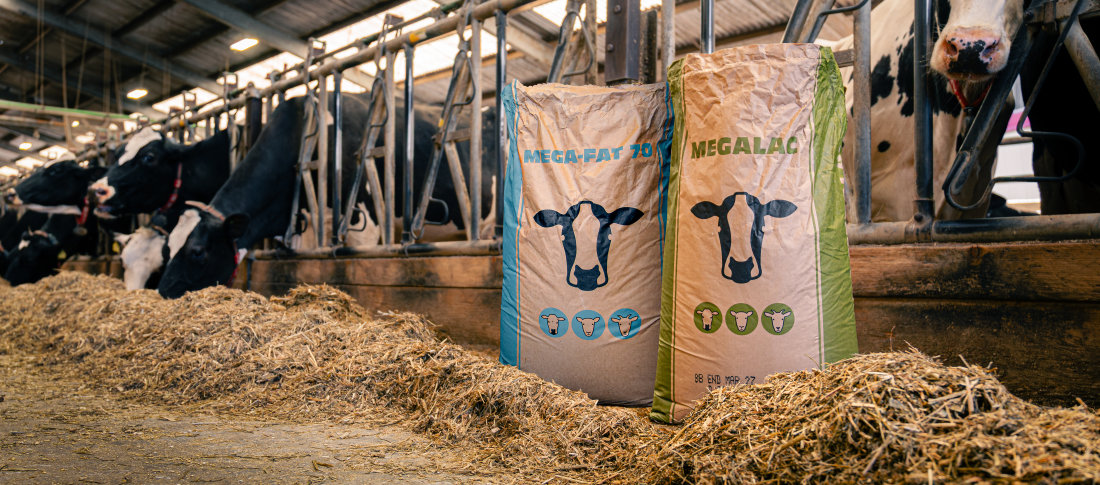
How rumen-protected fats support modern dairy production
Why modern dairy cows need more from their ration
Milk production, body condition, and fertility all depend on cows getting enough nutrition from the feed they consume. For high-performing cows, the priority is meeting those nutritional demands while protecting rumen function and making every kilogram of feed work as efficiently as possible.
Research from Cornell University shows what that can mean in practice. Megalac supplementation increased milk yield by 3.2 kg/day while improving feed efficiency, with cows producing more milk and milk solids per kilogram of feed consumed.
Fat can play an important role here. It provides around 2.5-times the energy concentration of cereals, making it a valuable way to increase the nutritional value of the ration without simply adding more feed.
But the type of fat matters.
Conventional fats and oils can interfere with the rumen microbes responsible for fibre digestion, limiting how much can be added safely. Rumen-protected fats offer a way around this. They are designed to pass through the rumen without disrupting normal fermentation, allowing cows to benefit from a concentrated source of dietary energy while continuing to make efficient use of the rest of the ration.
What are rumen-protected fats?
Rumen-protected fats – also known as bypass fats – are specially formulated so they remain stable as they pass through the rumen. This prevents the fatty acids from interfering with rumen microbes before they can be digested and absorbed further along the digestive tract.
There are two main ways this protection can be achieved:
- Calcium salts bind fatty acids with calcium to create a stable form that remains largely insoluble at normal rumen pH
- High-melting-point prills use saturated fatty acids that remain solid at rumen temperature
Once they leave the rumen, the fatty acids become available for digestion and absorption further along the digestive tract. Alongside helping protect rumen fermentation, this also limits changes to the fatty acids within the rumen, enabling more of the intended fatty acid profile to reach the small intestine for absorption and use by the cow. Cows can then access a concentrated source of dietary energy while rumen microbes continue breaking down fibre from the rest of the ration.
Why can’t you simply feed more fat?
For high-yielding dairy cows, fat can account for a significant proportion of the ration. As a general guideline, 15–20% of the metabolisable energy in a dairy cow’s diet can come from fat.
However, increasing fat levels requires choosing the source carefully. Unprotected oils can coat feed particles and create an ‘oil slick’ in the rumen, making it harder for fibre-digesting bacteria to do their job. As levels increase, this can reduce fibre digestion and potentially affect milk fat.
Rumen protection allows more fat to be included without the negative effects on rumen fermentation. The cow can benefit from the additional dietary energy, while the microbes in the rumen continue to breakdown fibre-rich feeds.
Their high energy density and low heat production during digestion and metabolism can also make rumen-protected fats particularly useful during heat stress, when feed intake typically falls.
How to choose the right fatty acid profile
C16:0 (palmitic acid) and C18:1 (oleic acid) are two of the most important fatty acids in dairy nutrition, but they support different production goals and stages of lactation. Two protected fats with similar inclusion rates can therefore produce different results depending on their fatty acid profile.
C16:0 is more closely associated with milk fat production and milk solids, making higher levels particularly useful during mid-to-late lactation if the production focus shifts towards milk fat output.
C18:1 is highly digestible and is particularly valuable during early lactation, when supporting fat digestion, body condition and fertility are priorities. Recent research in early-lactation cows found that increasing the proportion of C18:1 in supplemental fat increased milk yield and feed efficiency while reducing bodyweight loss.
The balance between the two can be tailored to your herd’s production goals. Blended fatty acid profiles can also support several outcomes at once, including milk production, body condition and fertility.
Fatty acid selection should ultimately reflect the stage of lactation and the response you want to achieve, rather than simply the total amount of fat in the ration.
Why product quality matters
Fatty acid profile is only part of the picture. How a rumen-protected fat is manufactured can affect how well that protection holds up inside the rumen.
For example, particle size is particularly important for calcium salts. Research found up to twice the breakdown of fine granules measuring less than 0.5 mm compared with larger 3–4 mm granules at typical rumen pH. Larger, more stable granules are therefore better able to carry fatty acids through the rumen before releasing them for digestion further along the digestive tract.
Stability can also vary according to the fatty acids used and the manufacturing process. When comparing products, farmers should look beyond the headline fat content and consider:
- The protection method used
- Fatty acid profile
- Granule size and product consistency
- Evidence of rumen stability
- Independent research supporting performance
These differences influence how reliably the fatty acids reach the small intestine and, ultimately, the value farmers get from supplementation.
Choosing the right fat for the job
Rumen-protected fats can provide a practical way to increase dietary energy while helping to protect normal rumen function, but there’s no single fatty acid profile or protected fat that suits every herd.
Start with what you want to achieve, whether that’s supporting milk production, improving milk solids, maintaining body condition or supporting fertility, then consider where cows are in lactation and how the product fits within the wider ration.
Looking at fatty acid profile alongside factors such as rumen stability, product quality and the research behind a product can help farmers and nutritionists make a more informed choice for the herd. Well-researched products such as Megalac have been developed with these principles in mind, providing a proven option within a wider protected fat feeding strategy.
Want to learn more about how rumen-protected fats can support dairy herd performance? Explore the latest technical resources from Megalac or speak to your nutritionist about how protected fats could fit within your feeding strategy.
Proven by science. Trusted by farmers.